
Example from a dedicated riflescope website: 3-9x42E, 6-24x50AOE, 10-40x56E-SF, etc.
3-9, 6-24, and 10-40: These indicate the magnification compared with the naked eye. Magnification makes it possible to see and identify distant targets clearly, and is suitable for precision shooting at long distances. Generally speaking, lower magnification is used to search for and aim at targets at close range, while higher magnification is used to shoot at distant targets. 42, 50, and 56: These indicate the diameter of the objective lens. In fact, the lens is enclosed in a metal housing, so the overall objective size will be slightly larger.
There is a common misconception that the larger the objective lens, the larger the field of view and the larger the target appears. This is incorrect. The size of the objective lens mainly affects brightness; the larger the objective lens, the better the brightness. The field of view is mainly determined by the internal structure of the riflescope, namely its Field of View parameter.
Electrical is the initial letter of the word “Electrical,” meaning illuminated, and does not specifically refer to red illumination. This is why many riflescope manufacturers call it “electro-optical.”
There is also a misconception that “E” generally represents red illumination, while “EG” represents both red and green illumination because G stands for Green in English. This explanation is incorrect. If this were the intended meaning, the designation should be RG. Riflescope manufacturers that use “G” to indicate red and green illumination and use “EG” for this purpose are applying the designation incorrectly.
AO: An abbreviation for Adjustable Objective. It provides parallax elimination and trajectory compensation.
The designations above have been inherited from Europe and the United States over the past several decades. In recent years, some designations have also been created domestically, such as: http://www.miaozhunq.com
SF: The initial letters of Side Focus, indicating that the focusing adjustment is located on the side.
S represents silver, meaning that the riflescope is silver-colored.
Technical specifications of riflescopes
Optical Coating (Coating): Applying a coating to the surface of a lens can reduce reflections and light loss caused by the lens, while also reducing eye fatigue. Coatings are generally made of fluoride and magnesium compounds. The more coating layers there are, the better the optical performance. Coatings are divided into the following types:
Coated: A single coating is applied to at least one lens.
Fully Coated: A single coating is applied to all lenses that come into contact with air.
Multi-Coated: Multiple coatings are applied to at least one lens, and all lenses receive at least one coating.
Fully Multi-Coated: Multiple coatings are applied to all lens surfaces that come into contact with air.
Exit Pupil (Exit Pupil): The diameter of the visible area in front of the riflescope eyepiece. The larger the exit pupil, the brighter the image. It is calculated by dividing the objective lens diameter by the magnification. For example, the exit pupil of a 3-9x40 riflescope is 4.44 mm-13.33 mm.
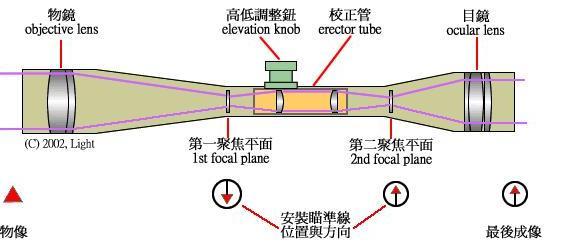
Eye Relief (Eye Relief): Also called the exit-pupil distance, this is the distance between the eye and the eyepiece. This distance is important for two main reasons. First, riflescopes are primarily used with firearms, which generate substantial recoil. If the eye directly contacts the eyepiece, it may be injured. Second, riflescopes use an erecting lens system and a Keplerian telescope system. The eye must be a certain distance from the eyepiece so that the eye, eyepiece, and objective lens remain as aligned as possible during observation. At high magnification, the riflescope should not be held directly by hand (a riflescope is not a telescope), so that the largest, roundest, and brightest image can be obtained. Eye relief changes slightly as the magnification changes.
Field of View (Field of View): The range of the field visible through the riflescope, generally measured with 100 yards or 100 meters as the reference distance. A large field of view provides more support for sports and moving targets. The field-of-view value is expressed in angular units and is generally smaller at higher magnification.
Precision Adjustment (Precision Adjustment): MOA (an abbreviation for Minute of Angle) is the unit used for the click value of the adjustment screws. The two knobs in the middle of the riflescope are used for precision adjustment. The knob generally marked “Up” adjusts the vertical, up-and-down direction, technically known as elevation adjustment. The other knob marked “R” adjusts the horizontal, left-and-right direction, known as windage adjustment. Generally speaking, there are three types of adjustment turrets: one click at 100 yards moves the point of impact by 1/2 inch, 1/4 inch, or 1/8 inch. The 1/2-inch adjustment is mainly used for miniature red-dot sights and low-magnification riflescopes, while high-variable-magnification riflescopes requiring precise aiming generally use 1/8-inch adjustment.
Material (Material): High-quality riflescopes are made of high-strength, durable aluminum alloy and undergo anodizing treatment. Each riflescope is rust-resistant and scratch-resistant, while also having an attractive appearance.
Sealing, Waterproofing, and Fog-proofing (Seal, Water-proof and Fog-proof): Thorough nitrogen filling can completely remove moisture from inside the riflescope, while high-quality O-rings prevent external moisture or dust from entering. If moisture and dust are present inside, they can easily settle on the internal lenses and cause fogging, resulting in mold growth that affects the performance and service life of the riflescope.
Parallax (Parallax): Parallax occurs when the target image cannot be accurately and clearly projected onto the reticle plane. When the shooter’s head moves, or under certain extreme conditions, an apparent displacement occurs between the reticle and the target, resulting in parallax. This causes the focus to be misaligned and the image to become blurred. Riflescope manufacturers generally set the parallax-free distance at 100 yards. For riflescopes used for close-range applications, such as shotguns, the parallax-free distance is set at 50 yards.