
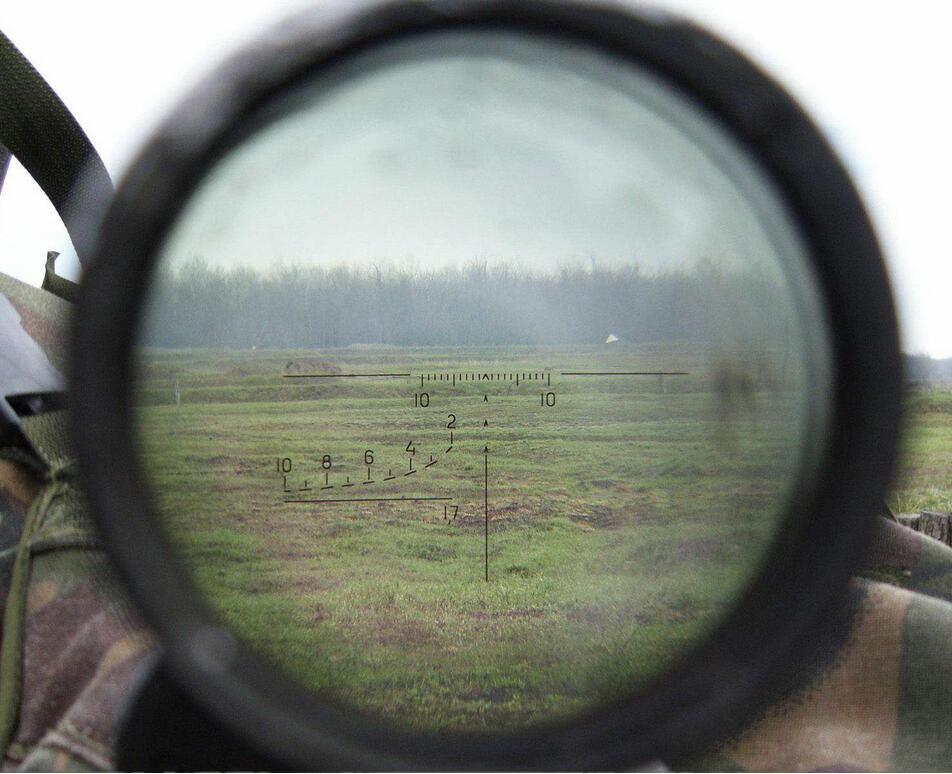
A riflescope is a precision instrument. Most users will look it over from every angle when they first receive it, and almost every button will be turned to see what it does. I believe I am not the only one who does this! However, while some buttons can be turned, others cannot, and each function button has its own purpose! We may know what they do, but we may not necessarily understand why they exist.
I. Diopter Adjustment
Since shooters differ in age and eyesight, every scope features diopter adjustment. It is primarily used to adjust the scope to the most suitable setting for different users. Some people have normal vision, some are nearsighted, some are farsighted, and some have astigmatism. The diopter adjustment ring on the eyepiece assembly changes the optical path of the eyepiece assembly, allowing it to match the user's eyesight as appropriately as possible.
Diopter adjustment is not achieved by turning the ring endlessly. During use, it should be turned slowly to the most suitable position. Sometimes the ring may be turned until it stops without achieving the correct adjustment; in that case, slowly turn it back to achieve the best result. The adjustment must be made slowly. Otherwise, on products of inferior quality, the sealing ring may accidentally come loose, or, in more serious cases, the lens may be damaged.
II. Windage and Elevation Adjustment Protective Caps
Except for some military scopes, most civilian scopes have protective caps to protect the internal windage and elevation adjustment turrets. These turrets are mainly used to make more precise vertical and horizontal adjustments to the reticle, making the crosshairs align more accurately with the target! The caps should be replaced immediately after adjustment to prevent the turrets from being exposed to rainwater and dust. Generally, these caps are made of aluminum and machined with imperial threads, so care should be taken when screwing them on and off because imperial threads are prone to stripping.
III. Windage and Elevation Adjustment Turrets
The windage and elevation adjustment turrets are also known as ballistic adjustment turrets. Their main function is to adjust the vertical and horizontal deviation of the projectile's point of impact. Ballistic adjustment turrets generally come in pairs: one for vertical adjustment and one for horizontal adjustment. The adjustment range is small but highly precise, and the turret graduations are generally indicated in 1/4 MOA. More precise scopes may have graduations as fine as 1/8 MOA. (MOA is a unit of shooting accuracy. In Chinese, it is translated as 分角, meaning 1/60 of 1 degree within 360 degrees.) In domestic calculations, one click of this turret generally corresponds to a 6 mm adjustment at 100 meters. There is some difference between the international and domestic conversions between meters and yards, and the actual value also varies by product.
IV. Objective Assembly Adjustment Ring
The objective assembly adjustment ring is essentially used to adjust magnification and focus. Magnification allows us to observe targets at greater distances. Since observation and shooting targets may be located at different distances—some at 100 meters and others at 1,000 meters—the distance between the image focus of the objective assembly and the reticle is not absolutely fixed when aiming at targets at different ranges. As the shooting distance changes, the reticle and the image focus of the objective may become misaligned within a certain range. When the eye moves up, down, left, or right at the eye-relief position, the crosshairs will also move accordingly.
For example, at 100 meters, 1x magnification may provide a sufficiently clear view, while at 200 meters, 2x magnification may be needed to see clearly, and so on. The higher the magnification, the closer distant targets appear; however, the field of view becomes narrower and less comprehensive. Therefore, before shipment, manufacturers set the objective focus at the most commonly used shooting distance, allowing users to adjust it to the position at which they can see clearly after receiving the scope.
The functions and application fields of each brand and product also differ. For example, Germany-based OLF focuses primarily on night-vision scopes, which can be used for nighttime hunting, law enforcement, and public security. Their functions are more extensive than those of the components mentioned above because they are night-vision scopes and additionally feature an infrared illuminator, reticle brightness adjustment, and other functions. The American RNO scopes, which specialize in thermal imaging technology, also differ slightly from those mentioned above, including in terms of buttons, ballistic adjustment turrets, and other components.