
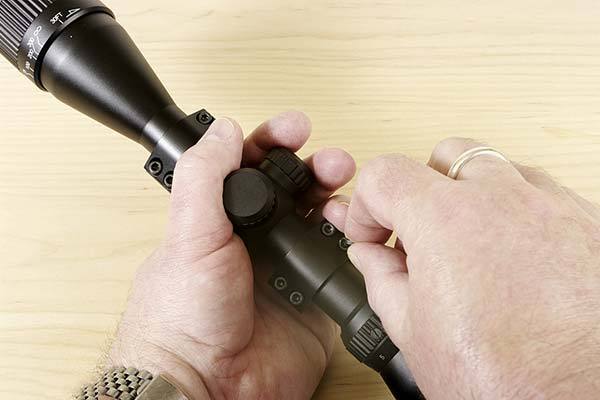
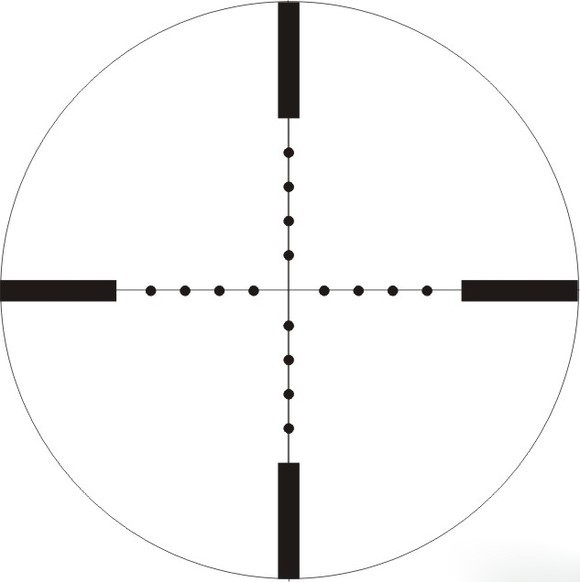
This mil-dot reticle scope first appeared in the steel Unertl high-magnification optical scopes used during the Vietnam War. In the early days, different reticles were used, but they were either too limited in function or overly complex and inconvenient to use. At first glance, this type of scope has many small positioning dots distributed along the crosshairs, which are used to measure distance. This reticle is known as a mil-dot reticle.
Today, many national militaries, law-enforcement agencies such as police forces, and some hunting scopes use this type of reticle.
In military applications, the surrounding circle is treated as a perfect circle and divided into 6,400 equal parts. In the scope, the distance between two dots represents one equal division, namely 1/6400.
For example, one division at a distance of 10,000 meters can be calculated using the following formula: 3.1415927x20000/6400=9.8174771875 meters, approximately 10 meters.
For example, one division at a distance of 1,000 meters can be calculated using the following formula: 3.1415927x2000/6400=0.98174771875 meters, approximately 1 meter.
Calculating the distance to a target is very simple. The following formula can be used: target length or height / mils X 1000
Let us use the example in this image to estimate a distance: in this case, the target is 100 meters away from the shooter.
In the image, we estimate the target based on the height of a Middle Eastern person. The average height of a European or American is 1.7 meters. In the image, the person’s height occupies approximately 1.7 divisions, namely
1.7 mils. We can now perform the calculation: Formula: height / mils x 1000
1.7/1.7x1000=1000 meters (yards)
It should be noted that in the actual design of a riflescope, one large division in the image is often not equal to one mil. Since the author has never used a genuine LEUPOLD riflescope, the calculation here assumes that one division equals one mil. In reality, one division in the image may represent five mils. Therefore, the person in the image may actually be approximately 200 meters away from the shooter.
Next, we will use an actual riflescope for measurement. The riflescope
is a VPOINT3.5-10X40. See the image below:
According to the data provided by the factory, this scope has a field of view 103 meters wide at a distance of 100 meters. We therefore drew an image. In the image, the black lines represent the scope’s reticle lines and reticle dots, while the outer black circle represents the imaging boundary of the scope. This circle has a diameter of 103 meters.
The red grid in the image was drawn to make it easier for users to view the image. One red square represents 1 meter in actual dimensions.
In the reticle, the distance between every two black dots represents approximately 0.4 meters at an actual distance of 100 meters. According to the formula, we know that under the international standard, one mil unit equals 0.1 meters at 100 meters. Therefore, each large division of this scope is equivalent to 4 mils.
I tested distant objects using the scope. First, I aimed at a building not far away. Since every floor of the building was the same height, I used it as a reference for distance measurement. I found that the distance between the lower edge of one window and the lower edge of the window on the floor above occupied approximately the distance of 5 black dots in the scope, or about 20 mils. Based on common architectural knowledge, residential buildings are generally 2.8 meters high per floor, so I applied the following formula:
2.8 (meters) / 20 (mils) X 1000 =140 meters.
Thus, the distant window was approximately 140 meters from my office.
I also conducted a test at a closer distance. I aimed at a nearby window with an A4 sheet of paper attached to it. After measuring it, I found that the narrow width of the A4 paper corresponded to approximately the distance between three black dots in the scope, and was slightly less—about 7 mils.
Because the narrow dimension of A4 paper is the internationally standardized size of 0.21 meters, I began the calculation:
0.21 (meters) / 7 x 1000 = 30 (meters)
The final calculation showed that I was 30 meters away from the sheet of paper.
In fact, I had previously measured the distance using a laser rangefinder. The precise distance from me to the red object was approximately 29.3 meters.
This demonstrates that distance measurement using mil-dots, together with the reasonable distribution of mil-dots on the VPOINT riflescope reticle, is relatively accurate.
Search