
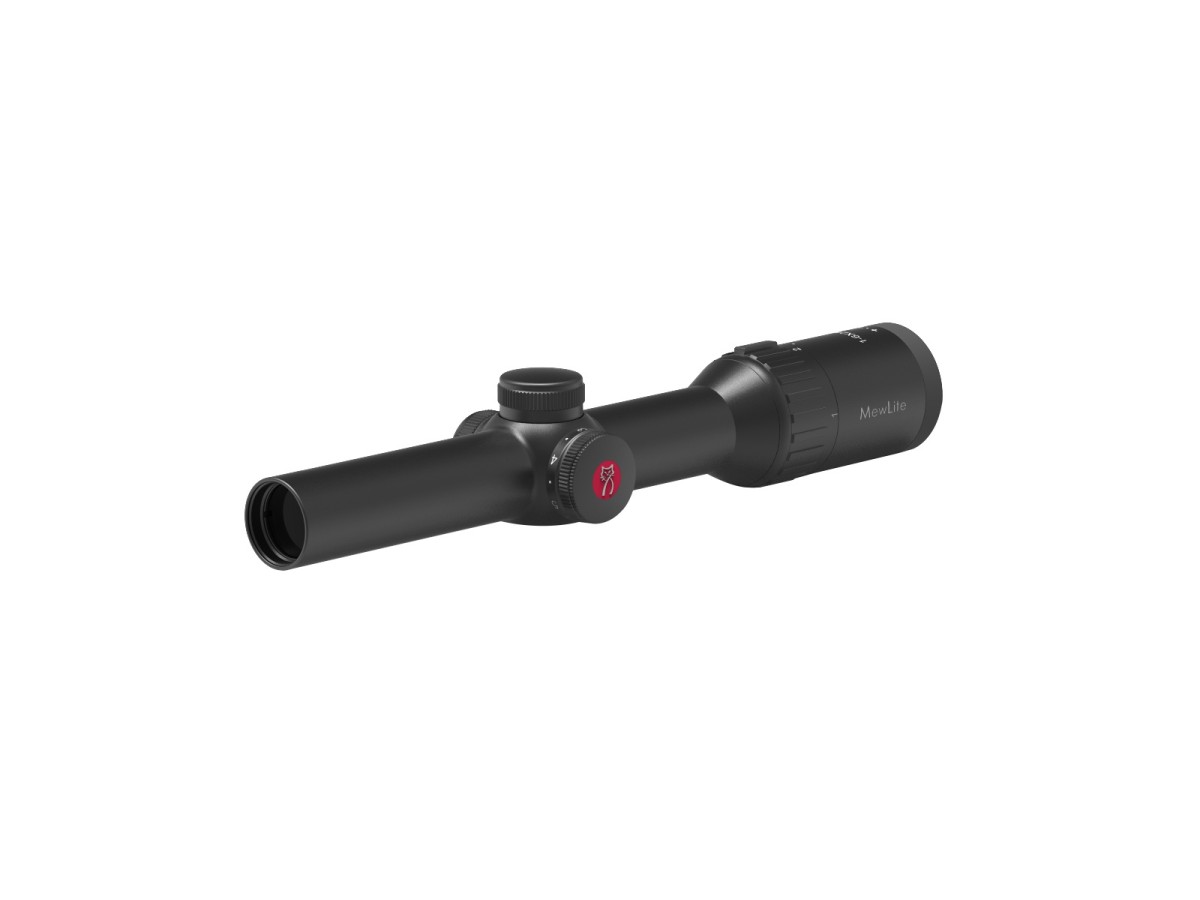
Optical sights are divided into two types: daylight sights and night-vision sights. Daylight sights are generally divided into three categories:
First, Keplerian daylight scopes. This is the most common type of optical sight. Essentially all products used by military forces, police, hunters, and shooting sports are of this type. The product has a simple structure and an extremely high adoption rate. It is currently one of the most common types of sight. A light illuminator is also installed above the eyepiece tube, mainly to illuminate the reticle for shooting at night.
Second, Galilean daylight scopes. This type is commonly used for anti-aircraft fire with heavy machine guns. It differs from sights designed for ground targets, so it will not be discussed in this article.
Third, reflex sights, commonly known in China as red-dot sights. These products are further divided into two types. One is the open-window type, which has a simple structure and low cost but is easily damaged by external forces. The other places the red dot inside a sight tube. This structure is reliable and not easily damaged. Many military models use the enclosed red-dot design.
Optical Principles of Telescopic Sights
In terms of operating mode, optical sights are divided into two categories. One is the purely optical sight, which is a combination of optical glass and mechanical components. This type mainly consists of daylight sights. The other is the optoelectronic sight. Optoelectronic sights are further divided into two branches: one is the night-vision sight, formed by combining early night-vision equipment; the other is the fully functional sight, which uses a fire-control system equipped with a laser rangefinder, display screen, and ballistic software. In the past, these sights were used for large weapons such as artillery and tanks. With the development of IC design and manufacturing, the size of fire-control accessories has been reduced to one-fifth or even one-tenth of its former size. These sights are now also available in firearm-specific models.
A Keplerian scope is essentially a monocular telescope consisting of two convex lenses. The imaging focal points of the two lenses coincide. A reticle is placed between the focal points of the two convex lenses. In this way, when people view a distant target through the telescope, the reticle at the imaging focal point can be precisely superimposed on the target, thereby enabling aiming.
Optical scopes generally use the Keplerian optical principle. Lens A in the figure is a simplified schematic diagram of a Keplerian optical scope. The two concave lenses interact with each other. When the focal points of the two lenses coincide, the eye sees a magnified image of a distant object. Generally speaking, the magnification is calculated by dividing the focal-length angle of the objective lens by that of the eyepiece. For example, in Figure A, if the angle of the eyepiece is four times that of the objective lens, the magnification of the telescope is four times.
Generally, a crosshair reticle is placed inside the telescope, with its position set at the point where the focal points of the objective lens and eyepiece coincide. At this point, the eye simultaneously sees the image of the object and the image of the crosshair reticle.
This is the principle of a telescopic sight. Military rifles, machine guns, and most telescopic sights all use this principle.
The function of the image-erecting lens group is to convert the image of a distant object into an upright image. Because a Keplerian telescope produces an image that is inverted both vertically and horizontally, operation of the scope would be impossible without an image-erecting lens group.
The function of the diopter adjustment mechanism is to accommodate differences in visual acuity. Different living environments can cause structural changes inside the human eye. Problems such as presbyopia and myopia may occur. The diopter lens adjusts and makes minor changes and corrections to the imaging beam of the optical scope so that, after entering the eye, it accommodates the slight differences in each person's ocular structure.
From the explanation above, we now have a general understanding of the internal structure of a telescopic sight.
Now let us describe the operating process of a telescopic sight in the simplest terms:
Suppose there is a deer in front of our scope. The objective lens uses the principle of lens imaging to converge the image of the distant deer onto the reticle, while the imaging focal point of the eyepiece also precisely coincides with the reticle.
When the eyepiece focal point, the objective-lens image point, and the reticle converge precisely on the same plane, precise aiming is achieved.
This is how an optical telescopic sight works. All military and civilian telescopic sights worldwide operate according to this principle. In actual telescopic sights, an image-erecting lens group is also included to convert the inverted image of the object into an upright image.